Looking after
your wood.
A quality wood cutting board or butcher block is one of the most actively used items in your kitchen. The care it needs is simple — but it matters. These are the practices I follow in my own kitchen, and they are what I recommend to everyone who takes a piece home.
Washing
Hand wash only — never submerge in water. Wipe the board with hot soapy water, rinse with hot water, then dry immediately with a clean dish towel. Store it upright in a dry area so air reaches both faces.
- Never submerge the board in water
- Never place it in a dishwasher or microwave
Disinfecting & deodorizing
With vinegar
Keep a spray bottle of white vinegar near your board. Acetic acid is an excellent disinfectant against E. coli, Salmonella, and common household bacteria. Spray the surface, let it sit for a few minutes, then wipe with a warm damp cloth.
With baking soda
For stains and deeper odors: combine 2 tablespoons of baking soda, 1 tablespoon of salt, and 3 tablespoons of hot water to form a paste. Scrub the entire surface, then wipe clean with a warm cloth and dry with a towel.
With coarse salt & lemon
Dampen the board with a warm cloth and sprinkle coarse salt over it. Cut a lemon in half and scour the surface with the cut side, squeezing gently as you go. Let it stand for five minutes, then scrub off the excess and dry.
Oiling & finishing
Treating the board regularly repels food particles and prevents stains and cracks. Oil at least once a month — twice if you use it daily. The board should be clean and fully dry before you apply anything.
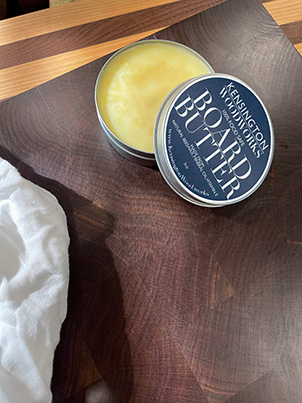
Board Butter
Every large board and butcher block leaves my shop with a tin of Board Butter — a blend of beeswax and food-safe mineral oil that I make by hand. The mineral oil penetrates the grain; the beeswax seals the surface. Using a small cloth, rub the paste into the board until absorbed, let it stand for 5–15 minutes, then buff in a circular motion with a clean cotton cloth until the finish is smooth.
Mineral oil alone
Food-safe mineral oil is available at any drug store or major retailer and is a safe, cost-effective way to maintain the wood. Apply with a clean cloth, spread evenly, and let it set for a few hours or overnight. Wipe off the excess with a dry cloth.
Making your own beeswax blend
If you prefer to make your own:
- In a small saucepan, measure ¼ cup of beeswax (chunked for quicker melting) and 1 cup of mineral oil. Stir constantly on low heat until the beeswax is completely dissolved. If the temperature is too high, the beeswax will discolor.
- Remove from heat and let stand for a minute, then pour into a sealed jar and let cool for a few hours, stirring once or twice every hour to keep it blended.
- Apply with a small cloth, rub into the board until absorbed, let stand for 5–15 minutes, and buff with a clean cotton cloth in a circular motion.
Never use vegetable oil, olive oil, or nut-based oils on your cutting board. They will spoil and become rancid, leaving an unpleasant smell and affecting the taste of food.
Using your board
Pair your board with sharp knives and apply minimal pressure. A sharp blade glides through food; a dull one crushes and gouges the wood. If your knives are dull, take them to a professional sharpener — the difference is dramatic, both in the kitchen and in how long your board lasts.
Questions about caring for a piece? Write me a note →